In the vast and intricate tapestry of Hindu mythology, Lord Vishnu stands as one of the most revered and central deities. As the Supreme Preserver, he forms the benevolent heart of the Trimurti, the holy trinity that includes Brahma the Creator and Shiva the Destroyer. While Brahma brings existence into being and Shiva facilitates its transformation, Lord Vishnu is the cosmic guardian, tirelessly working to maintain balance, order, and righteousness (Dharma) across all realms of existence. His unwavering commitment to protecting the universe from chaos and evil has made him a beacon of hope and a source of profound spiritual wisdom for millions of devotees worldwide.
This comprehensive guide will delve deep into the divine essence of Lord Vishnu, exploring his origins, his iconic Dashavatara (ten incarnations), the profound symbolism embedded in his attributes, and the powerful mantras dedicated to his worship. We will uncover the stories that define his character and understand the timeless lessons he offers for navigating the complexities of modern life.
1. The Origins and Cosmic Role of Lord Vishnu
The concept of Lord Vishnu is deeply rooted in Vedic traditions, where he is initially mentioned as a solar deity associated with light and cosmic order. Over millennia, his stature grew, and he became recognized as the Supreme Being in Vaishnavism, one of the largest denominations of Hinduism.
The Preserver in the Trimurti
As the Preserver, Lord Vishnu is responsible for the sustenance and protection of the universe. He intervenes whenever cosmic balance is threatened by malevolent forces, restoring Dharma and guiding humanity towards righteousness. His role is not merely reactive; it is an active, continuous process of upholding the delicate equilibrium of creation.
His Divine Abode: Vaikuntha
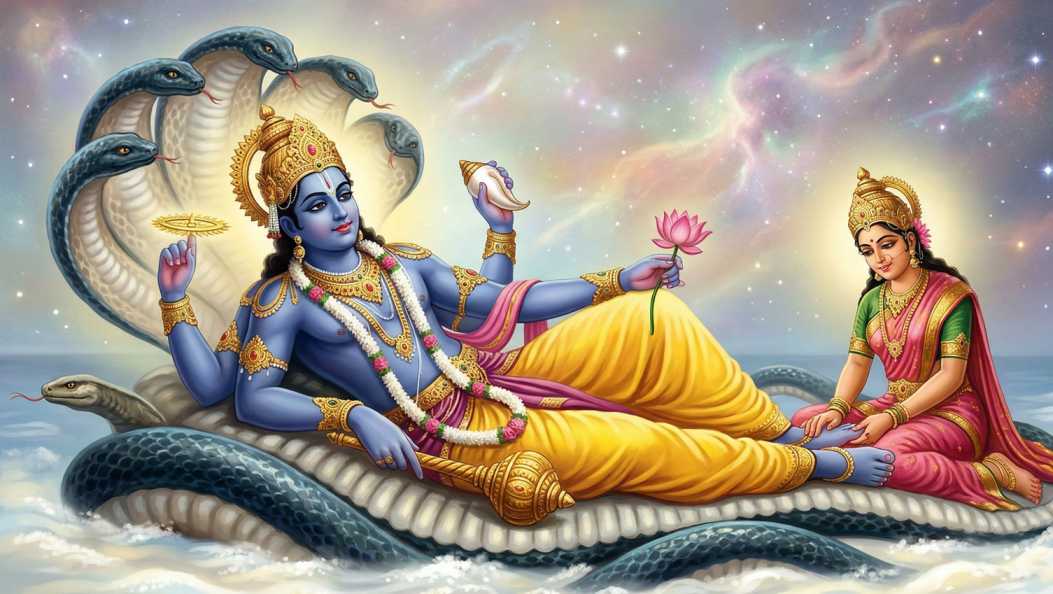
Lord Vishnu resides in Vaikuntha, a celestial realm of eternal bliss and unparalleled beauty. Here, he is often depicted reclining on Ananta-Shesha, the multi-headed cosmic serpent, accompanied by his consort, Goddess Lakshmi. Vaikuntha is a spiritual paradise, free from the cycles of birth and death, and is the ultimate destination for his devoted followers.
The Cosmic Sleep (Yoga Nidra)
Vishnu’s reclining posture on Sheshnag is known as Yoga Nidra or cosmic sleep. This state symbolizes the period between two cosmic cycles of creation and dissolution. From his navel, a lotus emerges, bearing Lord Brahma, who then commences the next cycle of creation. This imagery beautifully illustrates Vishnu’s role as the ultimate source and sustainer of all existence.
2. The Dashavatara: Lord Vishnu’s Ten Incarnations
Perhaps the most celebrated aspect of Lord Vishnu is his Dashavatara, the ten principal incarnations he takes to descend to Earth (Avatara literally means “descent”) to restore Dharma and protect his devotees. These avatars appear in different Yugas (epochs) to address specific cosmic crises.
The Purpose of Avatars
The Bhagavad Gita, a sacred Hindu scripture, states that Lord Vishnu manifests whenever righteousness declines and unrighteousness prevails. Each avatar serves a unique purpose, demonstrating divine power, wisdom, and compassion in various forms—from aquatic life to human heroes.
2.1. Matsya (The Fish)
The first avatar, Matsya, appeared during a great deluge to save humanity and the Vedas. Lord Vishnu, in the form of a giant fish, guided the sage Manu and his family, along with samples of all species, to safety in a boat, ensuring the continuity of life and knowledge.
2.2. Kurma (The Tortoise)
During the Samudra Manthan (Churning of the Ocean), the gods and demons used Mount Mandara as a churning rod. When the mountain began to sink, Lord Vishnu incarnated as Kurma, a giant tortoise, to support it on his back. This act enabled the retrieval of divine treasures, including Amrita (the nectar of immortality).
2.3. Varaha (The Boar)
When the demon Hiranyaksha dragged the Earth (Bhudevi) to the bottom of the cosmic ocean, Lord Vishnu took the form of Varaha, a mighty boar. He plunged into the waters, defeated the demon in a fierce battle, and lifted the Earth back to its rightful place on his tusks, symbolizing the rescue of the world from chaos.
2.4. Narasimha (The Man-Lion)
The demon king Hiranyakashipu, blessed with immunity from death by man or beast, day or night, inside or outside, on earth or in the sky, terrorized the universe. His devout son, Prahlada, remained a staunch devotee of Lord Vishnu. To protect Prahlada and uphold Dharma, Vishnu appeared as Narasimha—half-man, half-lion—at twilight, on the threshold of a courtyard, and placed Hiranyakashipu on his lap, then disemboweled him. This avatar signifies divine justice and protection of devotees.
2.5. Vamana (The Dwarf Brahmin)
King Bali, a benevolent but ambitious demon, had conquered the three worlds. To humble his pride and restore cosmic order, Lord Vishnu appeared as Vamana, a dwarf Brahmin. Vamana requested three paces of land. When Bali granted his wish, Vamana expanded to cosmic proportions, covering heaven and earth in two steps. For the third step, Bali offered his head, and Vamana sent him to the netherworld, granting him kingship there. This avatar teaches humility and the power of divine strategy.
2.6. Parashurama (The Warrior Sage)
Parashurama, the “Rama with an axe,” was a fierce warrior Brahmin who appeared to curb the arrogance of corrupt Kshatriya (warrior class) kings who had become tyrannical. Lord Vishnu in this form waged war against unrighteous rulers, restoring justice and protecting the Brahmins and the common people.
2.7. Rama (The Ideal King)
The seventh avatar is Lord Rama, the central figure of the epic Ramayana. As the ideal king, son, husband, and brother, Rama embodies righteousness, sacrifice, and unwavering adherence to Dharma. His life story, including his exile, the abduction of Sita, and his victory over the demon king Ravana, serves as a moral compass for humanity.
2.8. Krishna (The Divine Strategist)
Lord Krishna, the eighth and perhaps most beloved avatar, is a multifaceted deity—a mischievous child, a divine lover, a wise philosopher, and a supreme warrior. His teachings in the Bhagavad Gita, delivered to Arjuna on the battlefield of Kurukshetra, provide profound insights into duty, devotion, and the nature of reality.
2.9. Buddha (The Enlightened One)
In some Hindu traditions, Siddhartha Gautama, the founder of Buddhism, is considered the ninth avatar of Lord Vishnu. This incarnation is believed to have appeared to guide humanity away from excessive ritualism and towards compassion, non-violence, and spiritual enlightenment.
2.10. Kalki (The Future Warrior)
Kalki is the prophesied tenth and final avatar of Lord Vishnu, who is yet to appear. He is expected to manifest at the end of the current age (Kali Yuga) to eradicate evil, purify the world, and usher in a new era of righteousness (Satya Yuga). He is often depicted as a warrior on a white horse, wielding a flaming sword.

3. The Key Attributes and Symbols of Lord Vishnu
Every element associated with Lord Vishnu carries deep symbolic meaning, reflecting his divine nature and cosmic functions.
The Four Arms
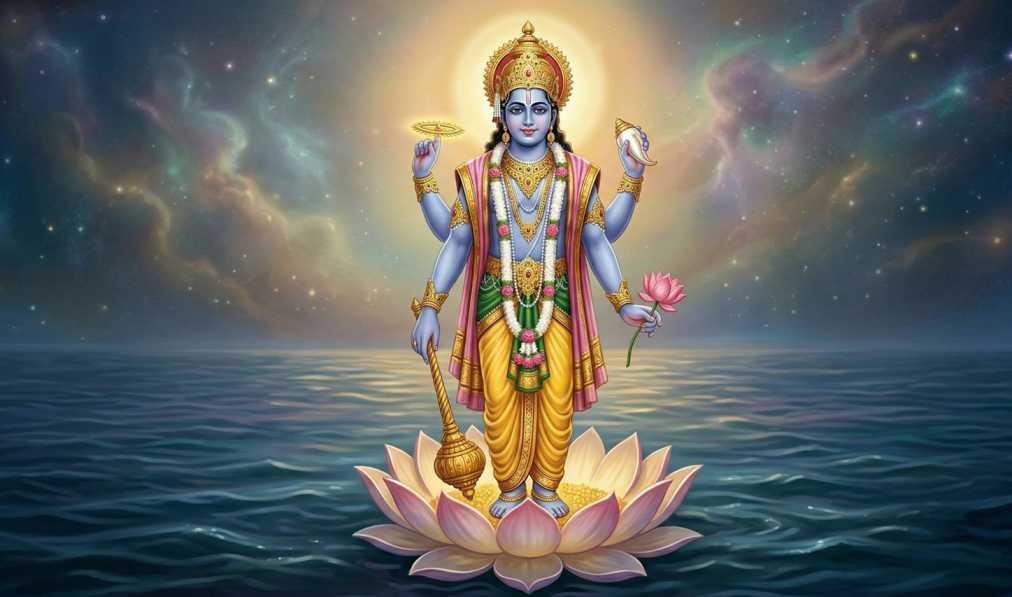
Lord Vishnu is typically depicted with four arms, each holding a distinct attribute:
- Conch (Panchajanya): Represents the primordial sound of creation (Om) and the divine call to spiritual awakening. Its sound dispels ignorance and evil.
- Chakra (Sudarshana Chakra): A spinning discus, symbolizing the mind, cosmic order, and the destruction of evil. It represents the wheel of time and the power to destroy illusion.
- Mace (Kaumodaki): Represents mental and physical strength, the power of knowledge, and the ability to punish unrighteousness.
- Lotus (Padma): Symbolizes purity, beauty, spiritual liberation, and the unfolding of creation. It signifies that one can live in the world without being tainted by its impurities.
His Divine Mount: Garuda
Garuda, the mighty eagle-like bird, is the vahana (mount) of Lord Vishnu. Garuda represents swiftness, courage, and the Vedas themselves. He carries Vishnu across the cosmos, symbolizing the flight of the soul towards liberation and the power of divine knowledge.
The Cosmic Serpent: Sheshnag (Ananta)
As mentioned earlier, Lord Vishnu reclines on Sheshnag, the king of all serpents. Sheshnag symbolizes the infinite (Ananta), cosmic energy, and the subconscious mind. His multiple hoods provide a canopy for Vishnu, representing protection and the vastness of cosmic time.
Blue Skin and Yellow Garment
Vishnu’s blue complexion symbolizes the infinite, like the vast sky and the deep ocean, representing his all-pervading nature. His yellow garment (Pitambara) signifies the Vedas and the golden light of the sun, representing knowledge and purity.
4. Powerful Lord Vishnu Mantras and Their Spiritual Benefits
Chanting mantras dedicated to Lord Vishnu is a potent spiritual practice believed to invoke his blessings, bring peace, prosperity, and spiritual growth.
Om Namo Narayanaya (The Ashtakshara Mantra)
This eight-syllable mantra is one of the most fundamental and powerful Vaishnava mantras. “Om” is the primordial sound, “Namo” means salutations, and “Narayanaya” refers to Narayana, another name for Lord Vishnu. Chanting this mantra is believed to purify the mind, remove obstacles, and lead to spiritual liberation.
Vishnu Gayatri Mantra
The Vishnu Gayatri Mantra is a powerful prayer for wisdom, enlightenment, and divine protection. It invokes the essence of Lord Vishnu to illuminate the intellect and guide the devotee towards righteousness.
The Mantra:
Om Narayanaya Vidmahe Vasudevaya Dhimahi Tanno Vishnu Prachodayat
Meaning: Om, let us meditate on Narayana, the son of Vasudeva. May Lord Vishnu enlighten our minds.
Hare Krishna Maha-Mantra
While primarily associated with Lord Krishna (an avatar of Vishnu), the Hare Krishna Maha-Mantra is also a powerful invocation of Lord Vishnu‘s energy. It is a universal prayer for peace, joy, and spiritual awakening.
The Mantra:
Hare Krishna, Hare Krishna, Krishna Krishna, Hare Hare
Hare Rama, Hare Rama, Rama Rama, Hare Hare
5. Major Festivals Dedicated to Lord Vishnu
Devotees of Lord Vishnu celebrate numerous festivals throughout the year, each commemorating a significant event or aspect of his divine play.
Vaikuntha Ekadashi
This auspicious day is observed in the Hindu month of Margashirsha (December-January). It is believed that on this day, the gates of Vaikuntha (Vishnu’s abode) are open, and observing a fast and performing prayers can lead to liberation.
Rama Navami
Rama Navami celebrates the birth of Lord Rama, the seventh avatar of Lord Vishnu. Devotees observe fasts, recite the Ramayana, and perform special pujas to honor his life and teachings.
Krishna Janmashtami
Krishna Janmashtami marks the birth of Lord Krishna, the eighth avatar of Lord Vishnu. It is celebrated with great fervor, with devotees fasting, singing devotional songs, and enacting scenes from Krishna’s life.
Diwali (Deepavali)
While a pan-Hindu festival, Diwali is deeply connected to Lord Vishnu and Goddess Lakshmi. It celebrates Lord Rama’s return to Ayodhya after defeating Ravana and also honors Lakshmi, the goddess of wealth and prosperity, who is Vishnu’s consort.
6. Philosophical Significance and Lessons from Lord Vishnu
The stories and attributes of Lord Vishnu offer profound philosophical insights and practical lessons for leading a righteous and fulfilling life.
Upholding Dharma
Lord Vishnu‘s primary role is to uphold Dharma, the cosmic law of righteousness. His avatars consistently demonstrate the importance of moral conduct, justice, and ethical living. For modern seekers, this emphasizes the need to act with integrity and contribute positively to society.
The Cycle of Preservation and Renewal
Vishnu’s interventions through his avatars highlight the cyclical nature of existence—creation, preservation, and dissolution. This teaches us that change is constant and that even in times of destruction, there is always the promise of renewal and a fresh start.
Devotion (Bhakti) and Surrender
The stories of Vishnu’s devotees, such as Prahlada, emphasize the power of unwavering faith and complete surrender to the divine. Bhakti Yoga, the path of devotion, is a central theme in Vaishnavism, promising liberation through love and dedication to Lord Vishnu.
Balance and Harmony
Vishnu’s consort, Lakshmi, represents wealth, prosperity, and auspiciousness. Their union symbolizes the importance of balancing spiritual pursuits with material well-being, recognizing that both are essential for a complete life.
7. Lord Vishnu in Modern Context: Timeless Wisdom
In an increasingly complex world, the teachings embodied by Lord Vishnu remain remarkably relevant.
- Leadership and Governance: Lord Rama’s reign (Rama Rajya) is often cited as the ideal model of governance, emphasizing justice, compassion, and welfare for all.
- Strategic Thinking: Lord Krishna’s role as a divine strategist in the Mahabharata teaches us the importance of wisdom, diplomacy, and decisive action in challenging situations.
- Environmental Stewardship: Avatars like Matsya, Kurma, and Varaha, who protect various forms of life and the Earth itself, underscore the Hindu reverence for nature and the need for ecological balance.
- Inner Peace and Stability: Meditating on Lord Vishnu can bring a sense of calm and stability, helping individuals navigate personal challenges with greater resilience.
8. Conclusion: The Eternal Guardian of Dharma
Lord Vishnu, the Supreme Preserver, is an eternal source of inspiration, protection, and spiritual guidance. His myriad forms and countless stories serve as a constant reminder of the divine presence that actively works to maintain cosmic order and guide humanity towards its highest potential. From the depths of the ocean to the celestial realms, his influence is all-pervading, offering solace and strength to those who seek his grace.
By understanding his Dashavatara, embracing his symbols, and chanting his sacred mantras, devotees can connect with the benevolent energy of Lord Vishnu, finding peace, purpose, and ultimately, liberation. May the blessings of the Supreme Preserver illuminate your path and fill your life with Dharma and prosperity.
Om Namo Narayanaya!
Read also: Lord Hanuman, Lord Krishna, Lord Shiva