
Introduction: Unveiling the Sacredness of Somnath Jyotirlinga
On the pristine shores of the Arabian Sea in Gujarat, stands one of India’s most revered and ancient temples – the Somnath Jyotirlinga Temple. Dedicated to Lord Shiva, this temple is not just a place of worship; it is a symbol of faith, resilience and the undying spirit of Hindu culture. As the first among the twelve sacred Jyotirlingas of Lord Shiva, Somnath holds a special place in the hearts of millions of devotees worldwide. For thousands of years, people have flocked to this sacred abode to seek the blessings of Lord Somnath, the Lord of the Moon.
In this comprehensive guide, we will explore everything you need to know about Somnath Jyotirlinga. From its sacred history and legends to its destruction and reconstruction, architecture, timings and how to reach, we will cover it all. We will also delve into the significance of Somnath being the first Jyotirlinga, the festivals celebrated here and the benefits of visiting this divine temple. Whether you are planning a pilgrimage or simply curious about this sacred place, this article will illuminate your path and help you connect with the divine energy of Somnath Jyotirlinga.
What is Somnath Jyotirlinga?
The Somnath Jyotirlinga Temple is the first among the twelve sacred Jyotirlingas of Lord Shiva. A Jyotirlinga is a self-manifested pillar of light, representing the infinite and formless nature of Lord Shiva. The term “Somnath” means “Lord of the Moon” (Soma = Moon, Nath = Lord) and the temple is dedicated to this form of Lord Shiva.
Located in the Prabhas Patan area of Veraval in Gujarat, the Somnath Jyotirlinga Temple sits at the confluence of three rivers – Kapila, Hiran and Saraswati. This confluence, known as Triveni Sangam, adds to the temple’s sacredness. The temple is also mentioned in several ancient Hindu scriptures, including the Rig Veda, Shiv Purana and Mahabharata, which further emphasizes its importance.
The presiding deity of the Somnath Jyotirlinga Temple is Lord Somnath, a form of Lord Shiva. The idol of Lord Somnath is believed to be swayambhu (self-manifested), which means it was not carved by human hands but appeared naturally. This makes the temple even more sacred and powerful. Every day, thousands of devotees visit the temple to seek Lord Somnath’s blessings and experience his divine presence.
The Sacred Legend of Somnath Jyotirlinga
The history of Somnath Jyotirlinga is rich, fascinating and deeply rooted in Hindu mythology. Let’s explore its sacred story:
The Legend of the Moon God (Chandra)
One of the most famous legends associated with Somnath Jyotirlinga is the story of the Moon God, Chandra. According to the legend, Chandra was married to the twenty-seven daughters of Daksha Prajapati. However, Chandra was particularly fond of Rohini, one of his wives and he neglected the others. This made Daksha angry and he cursed Chandra to lose his radiance.
Devastated by the curse, Chandra went to Lord Brahma for help. Lord Brahma advised him to worship Lord Shiva at Prabhas Patan. Following Lord Brahma’s advice, Chandra came to Prabhas Patan and performed severe penance to please Lord Shiva. Pleased with Chandra’s devotion, Lord Shiva appeared before him and asked him what boon he wanted.
Chandra requested that Lord Shiva stay in Prabhas Patan forever to bless all devotees and that his radiance be restored. Lord Shiva agreed and manifested himself as the Somnath Jyotirlinga. He also restored Chandra’s radiance, but with a condition – Chandra’s radiance would wax and wane every month. This is why we have the phases of the moon today.
Since then, Lord Somnath has been residing in Prabhas Patan, blessing everyone who comes to him with a pure heart. The Somnath Jyotirlinga is also known as the “Moon God’s Temple” because of this legend.
The Legend of Lord Krishna
Another important legend associated with Somnath Jyotirlinga is the story of Lord Krishna. According to the Mahabharata, Lord Krishna spent his final days in Prabhas Patan. It is believed that Lord Krishna left his mortal body here and the place where he left is known as “Dehotsarg” (the place of departure of the body).
Lord Krishna’s connection to Somnath Jyotirlinga adds to its sacredness. Devotees believe that visiting Somnath Jyotirlinga and paying homage to Lord Krishna’s Dehotsarg can help them attain moksha (liberation from the cycle of birth and death).
The Turbulent History of Destruction and Reconstruction
The Somnath Jyotirlinga Temple has a turbulent and inspiring history. It has been destroyed and rebuilt seventeen times over the centuries, yet it has always stood tall as a symbol of faith and resilience. Let’s explore its history:
Early History
The Somnath Jyotirlinga Temple is believed to have been built for the first time by Lord Krishna’s grandson, Vajranabh, in the 1st millennium BCE. However, some historical records suggest that the temple was even older, dating back to the time of the Mahabharata. Over the centuries, the temple was rebuilt several times by various rulers, including the Solanki dynasty and the Chaulukya dynasty.
Destruction by Mahmud of Ghazni
The first major destruction of the Somnath Jyotirlinga Temple occurred in 1025 CE, when Mahmud of Ghazni invaded Gujarat. Mahmud of Ghazni was a Turkish ruler who was known for his raids on Indian temples. He attacked the Somnath Temple, looted its treasures and destroyed the Shivalinga. The destruction of the Somnath Temple was a great blow to Hindu culture and spirituality, but it also sparked a sense of resilience and unity among Hindus.
Subsequent Destructions and Reconstructions
After Mahmud of Ghazni’s invasion, the Somnath Jyotirlinga Temple was rebuilt, but it was destroyed again several times by other invaders, including Alauddin Khalji in 1299 CE, Muzaffar Shah I in 1395 CE and Aurangzeb in 1706 CE. Each time the temple was destroyed, it was rebuilt by Hindu rulers and devotees, showing their unwavering faith and devotion to Lord Shiva.
Reconstruction After Independence
After India gained independence in 1947, the Somnath Jyotirlinga Temple was rebuilt once again, this time under the leadership of Sardar Vallabhbhai Patel, the first Deputy Prime Minister of India. The reconstruction of the temple was completed in 1951 and it was inaugurated by the first President of India, Dr. Rajendra Prasad.
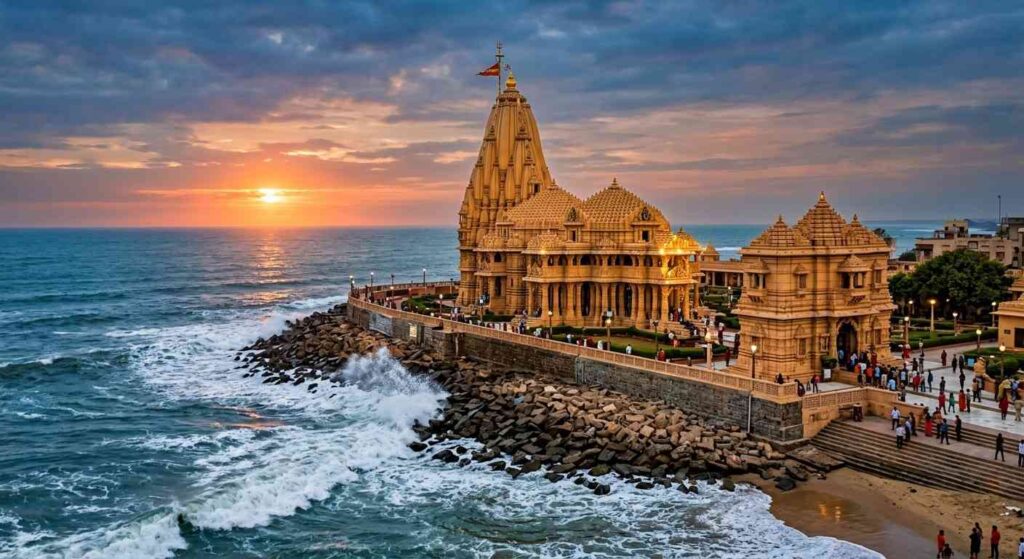
The current structure of the Somnath Jyotirlinga Temple is a beautiful blend of ancient and modern architecture. It stands proudly on the shores of the Arabian Sea, as a symbol of faith, resilience and the undying spirit of Hindu culture.
The Magnificent Architecture of Somnath Jyotirlinga
The Somnath Jyotirlinga Temple is a masterpiece of Hindu architecture. Let’s explore its beautiful structure:
The Main Temple
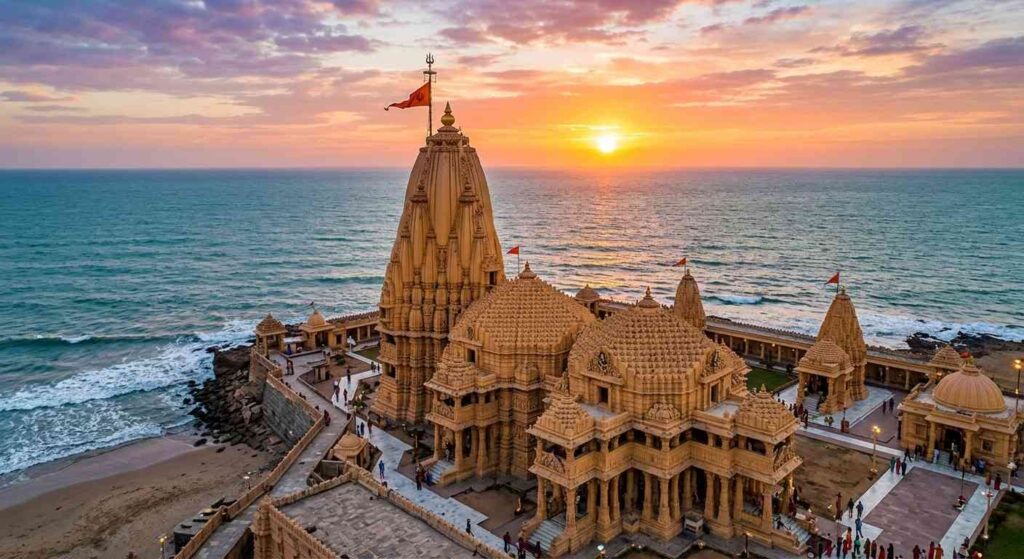
The main temple of Somnath Jyotirlinga is a three-story structure, built in the Chalukya style of architecture. The temple is made of pink sandstone and it is adorned with intricate carvings and beautiful sculptures. The walls of the temple are decorated with scenes from Hindu mythology, including the life of Lord Shiva, the legend of the Moon God and the story of Lord Krishna.
The top of the temple is crowned with a beautiful shikhara (spire), which is about 155 feet tall. The shikhara is adorned with sculptures of gods and goddesses and it is a stunning sight to behold, especially at sunset when it glows in the golden light. The temple’s entrance is a magnificent gateway, with intricate carvings and beautiful pillars.
The Garbhagriha (Sanctum Sanctorum)
The Garbhagriha, or sanctum sanctorum, is the most sacred part of the Somnath Jyotirlinga Temple. It is here that the swayambhu (self-manifested) Shivalinga of Lord Somnath is installed. The Shivalinga is black in color and it is about 18 inches tall. It is adorned with silver and gold ornaments and it is a breathtaking sight.
The Garbhagriha is accessible only to the temple priests. Devotees can see the Shivalinga from a distance and they can offer their prayers and offerings. The atmosphere in the Garbhagriha is filled with divine energy and devotees often feel a sense of peace and tranquility when they enter this sacred space.
The Sabha Mandapa (Assembly Hall)
In front of the Garbhagriha, there is a Sabha Mandapa, or assembly hall. The Sabha Mandapa is a large, open hall with beautiful pillars and intricate carvings. It is used for religious ceremonies and gatherings and it can accommodate thousands of devotees at a time. The Sabha Mandapa is a beautiful place to meditate and reflect and it offers a stunning view of the main temple.
The Arabian Sea View
One of the most unique features of the Somnath Jyotirlinga Temple is its location on the shores of the Arabian Sea. The temple offers a stunning view of the sea and the sound of the waves adds to its sacred atmosphere. Devotees often sit on the temple’s steps, watching the sunset over the sea and offering their prayers to Lord Somnath. The sea view makes the Somnath Jyotirlinga Temple one of the most beautiful and serene temples in India.
Why Somnath is the First Jyotirlinga
The Somnath Jyotirlinga is the first among the twelve sacred Jyotirlingas of Lord Shiva. But why is that? Let’s explore the significance of Somnath being the first Jyotirlinga:
According to the Shiv Purana
According to the Shiv Purana, once Lord Brahma and Lord Vishnu had an argument about who was the supreme deity. To settle the dispute, Lord Shiva appeared as a massive pillar of light, stretching from heaven to earth. He challenged Lord Brahma and Lord Vishnu to find the beginning or end of the pillar.
Lord Brahma took the form of a swan and flew upwards, while Lord Vishnu took the form of a boar and dug downwards. Neither could find the end of the pillar. Finally, they accepted Lord Shiva as the supreme deity. The place where Lord Shiva appeared as this pillar of light is believed to be Somnath Jyotirlinga, which is why it is considered the first Jyotirlinga.
The Legend of the Moon God
As we discussed earlier, the Somnath Jyotirlinga is associated with the Moon God, Chandra. Chandra was the first to worship Lord Shiva at this place and Lord Shiva manifested himself here as the first Jyotirlinga. This is another reason why Somnath is considered the first Jyotirlinga.
Its Historical and Cultural Significance
The Somnath Jyotirlinga Temple is one of the oldest temples in India, with a history dating back thousands of years. It has been mentioned in several ancient Hindu scriptures and it has always been a center of spiritual and cultural activity. Its historical and cultural significance also contributes to its status as the first Jyotirlinga.
Being the first Jyotirlinga, Somnath Jyotirlinga holds a special place in the hearts of devotees. It is believed that visiting Somnath Jyotirlinga first and then visiting the other eleven Jyotirlingas brings special blessings.
Somnath Jyotirlinga Timings and Darshan Details
If you are planning a visit to Somnath Jyotirlinga, it is important to know the temple timings and darshan details. Here is all the information you need:
Temple Timings
The Somnath Jyotirlinga Temple is open every day of the year. Here are the regular timings:
- 6:00 AM – 12:30 PM: Morning session
- 12:30 PM – 3:00 PM: Midday session (including Bhog Aarti at 12:00 PM)
- 3:00 PM – 9:00 PM: Evening session (including Sandhya Aarti at 7:00 PM)
- 9:00 PM – 9:30 PM: Shayan Aarti
Please note that the temple timings may change during festivals and special occasions. It is advisable to check the official website of the Somnath Jyotirlinga Temple or contact the temple authorities before planning your visit.
Darshan Types
There are several types of darshan available at Somnath Jyotirlinga:
- Free Darshan: This is the regular darshan, which is free of charge. Devotees can enter the temple in a queue and have darshan of Lord Somnath from a distance.
- Paid Darshan: There are several paid darshan options available, which allow devotees to have darshan from a closer distance and avoid long queues. The paid darshan tickets can be purchased online or at the temple counter.
- VIP Darshan: VIP darshan is available for special guests and dignitaries. It allows them to have darshan from a very close distance and skip all queues.
It is important to note that during festivals and peak seasons, the temple gets very crowded, so it is advisable to book your darshan tickets in advance.
Festivals Celebrated at Somnath Jyotirlinga
The Somnath Jyotirlinga Temple celebrates several festivals with great enthusiasm and devotion. Here are some of the most important festivals:
1. Mahashivratri
Mahashivratri is the most important festival celebrated at Somnath Jyotirlinga. It is celebrated in the month of February or March and it commemorates the marriage of Lord Shiva and Goddess Parvati. On this day, the temple is decorated beautifully with flowers, lights and rangoli. Special rituals and ceremonies are performed, including Abhishekam (sacred bathing) of the Shivalinga with milk, water and honey. Thousands of devotees gather at the temple to offer their prayers and seek the blessings of Lord Somnath. The temple remains open throughout the night on Mahashivratri and devotees can have darshan of Lord Somnath at any time.
2. Somnath Temple Anniversary
The Somnath Jyotirlinga Temple celebrates its anniversary on the 8th of May every year. This day marks the inauguration of the current temple structure in 1951. On this day, special rituals and ceremonies are performed and the temple is decorated beautifully. Devotees come from far and wide to celebrate this special occasion and seek the blessings of Lord Somnath.
3. Kartik Purnima
Kartik Purnima is celebrated in the month of Kartik (October-November), on the full moon day. It is believed that taking a dip in the Arabian Sea at Somnath Jyotirlinga on Kartik Purnima can wash away all sins. The temple is decorated beautifully on this day and special rituals and ceremonies are performed. Thousands of devotees gather at the temple and the Arabian Sea to celebrate this sacred festival.
4. Navratri
Navratri is another important festival celebrated at Somnath Jyotirlinga. It is celebrated twice a year – in the month of Chaitra (March-April) and Ashwin (September-October). During Navratri, nine forms of Goddess Durga are worshipped for nine days. The Somnath Jyotirlinga Temple is decorated beautifully during Navratri and special rituals and ceremonies are performed. Many devotees fast during Navratri and visit the temple every day to offer their prayers.
How to Reach Somnath Jyotirlinga
Somnath is well-connected to all major cities in India by road, rail and air. Here is all the information you need to reach Somnath Jyotirlinga:
By Air
The nearest airport to Somnath Jyotirlinga is the Diu Airport, which is about 85 kilometers away. The airport has regular flights to Mumbai and other major cities in India. From the airport, you can hire a taxi or take a bus to reach Somnath. The journey takes about 2-3 hours.
Another nearby airport is the Rajkot Airport, which is about 190 kilometers away. The airport has regular flights to Mumbai, Delhi and other major cities in India. From the airport, you can hire a taxi or take a bus to reach Somnath. The journey takes about 4-5 hours.
By Train
The nearest railway station to Somnath Jyotirlinga is the Veraval Railway Station, which is about 7 kilometers away. The railway station is well-connected to all major cities in India, including Mumbai, Ahmedabad and Rajkot. From the railway station, you can hire a taxi, auto-rickshaw, or take a bus to reach the temple. The journey takes about 15-20 minutes.
By Road
Somnath is well-connected to all major cities in Gujarat and neighboring states by road. There are regular buses to Somnath from Ahmedabad, Rajkot, Veraval and other major cities. You can also drive to Somnath in your own vehicle. The Somnath Jyotirlinga Temple is located in the heart of the city and it is easily accessible by road.
Benefits of Visiting Somnath Jyotirlinga
Visiting Somnath Jyotirlinga is a life-changing experience. Here are some of the benefits of visiting this sacred temple:
- Protection from Evil: Lord Somnath is the Lord of the Moon and the Destroyer of Evil. Visiting Somnath Jyotirlinga and seeking his blessings can protect you from negative energies, evil eyes and dangers.
- Peace of Mind: In today’s fast-paced world, peace of mind is a rare commodity. Visiting Somnath Jyotirlinga and experiencing his divine presence can give you inner peace and tranquility that no material possession can give.
- Fulfillment of Desires: Whatever your heart desires, visiting Somnath Jyotirlinga and seeking his blessings with a pure heart can help it come true. Lord Somnath is always ready to help his devotees and he fulfills all their wishes.
- Removal of Sins: Taking a dip in the Arabian Sea at Somnath Jyotirlinga and visiting the temple can wash away all your sins, both intentional and unintentional. It can help you start your life afresh with a clean slate.
- Spiritual Growth: Somnath Jyotirlinga is a sacred place and visiting this temple can help you grow spiritually. It can help you connect with Lord Shiva and attain higher consciousness.
- Good Health and Longevity: Lord Somnath is the Lord of the Moon, which is associated with health and longevity. Visiting Somnath Jyotirlinga and seeking his blessings can grant you good health and longevity.
- Prosperity and Wealth: Lord Somnath is also the bestower of prosperity and wealth. Visiting Somnath Jyotirlinga and seeking his blessings can remove financial difficulties and attract prosperity into your life.
These are just a few of the many benefits of visiting Somnath Jyotirlinga. The more you visit this sacred temple, the more you will experience its divine power in your life.
Tips for a Successful Visit to Somnath Jyotirlinga
If you are planning a visit to Somnath Jyotirlinga, here are some tips to make your visit successful and memorable:
- Plan Your Visit in Advance: Somnath Jyotirlinga is a very popular temple and it receives millions of visitors every year. It is advisable to plan your visit in advance, especially during festivals and peak seasons. Book your accommodation and transport in advance to avoid any last-minute hassles.
- Dress Modestly: When visiting Somnath Jyotirlinga, it is important to dress modestly. Men should wear shirts and pants and women should wear sarees, salwar kameez, or other modest clothing. Avoid wearing revealing clothes, as it is considered disrespectful.
- Maintain Purity: Before entering Somnath Jyotirlinga, it is important to maintain purity. Take a bath and wear clean clothes. If a bath is not possible, at least wash your hands, feet and face. Avoid entering the temple with shoes on.
- Follow the Rules: Somnath Jyotirlinga has certain rules and regulations that all visitors must follow. Follow these rules and regulations to ensure a smooth and hassle-free visit. Do not take photographs inside the temple without permission.
- Be Respectful: When visiting Somnath Jyotirlinga, be respectful to the temple priests, staff and other visitors. Maintain silence inside the temple and avoid using your phone. Focus on your prayers and the divine presence of Lord Somnath.
- Offer Your Prayers with a Pure Heart: When visiting Somnath Jyotirlinga, offer your prayers with a pure heart and complete devotion. Do not ask for material possessions; instead, ask for spiritual growth, inner peace and the well-being of your family and friends. Lord Somnath will take care of all your needs.
- Take a Dip in the Arabian Sea: If possible, take a dip in the Arabian Sea at Somnath Jyotirlinga. It is believed that taking a dip in this sea can wash away all sins and purify your soul.
- Explore the Surrounding Areas: Somnath Jyotirlinga is located in a beautiful area with many other places of interest. After visiting the temple, take some time to explore the surrounding areas, such as the Triveni Sangam, Dehotsarg and the Somnath Beach.
By following these tips, your visit to Somnath Jyotirlinga will be successful, memorable and spiritually uplifting.
Why Somnath Jyotirlinga is More Relevant Than Ever in 2026
In 2026, the world is changing faster than ever. People are struggling with stress, anxiety and uncertainty. In this situation, Somnath Jyotirlinga is more relevant than ever. Here are a few reasons why:
- Mental Health Crisis: The post-pandemic world is facing a mental health crisis. Visiting Somnath Jyotirlinga and experiencing his divine presence can help reduce stress and anxiety and give you inner peace.
- Uncertainty About the Future: The world is changing rapidly and many people are uncertain about the future. Somnath Jyotirlinga is the Lord of the Moon, which represents change and transformation. Seeking his blessings can give you stability and hope for the future.
- Rise in Spiritual Seekers: More and more people are turning to spirituality for answers. Somnath Jyotirlinga is a sacred place and visiting this temple can help you grow spiritually and connect with Lord Shiva.
- Need for Protection: In today’s world, there are many negative energies and dangers. Somnath Jyotirlinga is the Destroyer of Evil and seeking his blessings can protect you from negative energies and dangers.
In 2026, make a plan to visit Somnath Jyotirlinga. Let Lord Somnath guide you through the darkness and bless you with prosperity, longevity and spiritual growth.
Conclusion: Embrace the Divine Power of Somnath Jyotirlinga
As we conclude this ultimate guide, we have explored everything you need to know about Somnath Jyotirlinga. From its sacred history and legends to its destruction and reconstruction, architecture, timings and how to reach, we have covered it all. Somnath Jyotirlinga is not just a temple; it is a symbol of faith, resilience and the undying spirit of Hindu culture.
Visiting Somnath Jyotirlinga is a life-changing experience. It can help you grow spiritually, connect with Lord Shiva and attain inner peace and tranquility. In 2026, as the world becomes faster and more stressful, this sacred place is more relevant than ever.
May Lord Somnath bless you and your family. May he protect you from all evil, grant you good health and longevity and help you grow spiritually. Om Namah Shivaya! Jai Somnath!
Frequently Asked Questions (FAQs)
1. What is Somnath Jyotirlinga?
Somnath Jyotirlinga is the first among the twelve sacred Jyotirlingas of Lord Shiva. It is located in Prabhas Patan, Veraval, Gujarat, on the shores of the Arabian Sea.
2. Why is Somnath the first Jyotirlinga?
According to the Shiv Purana, Somnath Jyotirlinga is the place where Lord Shiva first appeared as a massive pillar of light to settle the dispute between Lord Brahma and Lord Vishnu. It is also associated with the Moon God, Chandra, who was the first to worship Lord Shiva here.
3. How many times was the Somnath Temple destroyed?
The Somnath Jyotirlinga Temple has been destroyed and rebuilt seventeen times over the centuries. The current structure was completed in 1951, after India gained independence.
4. What are the temple timings of Somnath Jyotirlinga?
The Somnath Jyotirlinga Temple is open every day of the year. Here are the regular timings:
- 6:00 AM – 12:30 PM: Morning session
- 12:30 PM – 3:00 PM: Midday session
- 3:00 PM – 9:00 PM: Evening session
- 9:00 PM – 9:30 PM: Shayan Aarti
5. How can I reach Somnath Jyotirlinga?
Somnath is well-connected to all major cities in India by road, rail and air. The nearest airport is Diu Airport (85 km), the nearest railway station is Veraval Railway Station (7 km) and it is also well-connected by road.
Disclaimer: This article is for informational and spiritual education purposes only. Please verify the information with trusted sources before planning your visit.