Lord Shiva, often referred to as Mahadev (the Great God), is one of the most revered and complex deities in Hinduism. As a core member of the Hindu Trinity (Trimurti), alongside Brahma the Creator and Vishnu the Preserver, Lord Shiva holds the unique role of the Destroyer and Transformer. This destruction, however, is not a negative force but a necessary process for renewal and rebirth. In this comprehensive guide, we will delve deep into the origins, symbols, stories, and spiritual significance of Lord Shiva, providing you with everything you need to know about the “Auspicious One.”
1. The Origins and Mythology of Lord Shiva
The origins of Lord Shiva are as mysterious as the deity himself. Unlike other gods who have clearly defined lineages in the Puranas, Shiva is often described as Swayambhu (self-manifested). He is the beginning and the end, the source of all consciousness.
Shiva in the Vedas and Puranas
The earliest mentions of a deity resembling Shiva appear in the Rig Veda as “Rudra,” a fierce storm god associated with the wild and the hunt. Over centuries, this fierce persona evolved into the more benevolent and meditative figure we recognize today as Lord Shiva. The Shiva Purana, one of the eighteen major Puranas, provides extensive details about his life, his family, and his various manifestations. It describes him as the absolute reality, the Brahman itself, who takes form to guide the universe.
The Birth of Shiva (Swayambhu)
One popular legend describes the appearance of a massive pillar of fire (Jyotirlinga) before Brahma and Vishnu. When both gods attempted to find the top and bottom of this pillar, they failed, only for Lord Shiva to emerge from the fire, establishing his supremacy as the eternal reality. This story highlights Shiva’s status as a being beyond the constraints of time and space. It is said that Shiva was never born in the traditional sense; he has always existed as the silent witness of the cosmic dance.
2. The Key Attributes and Symbols of Lord Shiva
Every aspect of Lord Shiva‘s appearance is symbolic, representing profound spiritual truths. Understanding these symbols is essential for any devotee or seeker of wisdom.
The Third Eye (Trinetra)
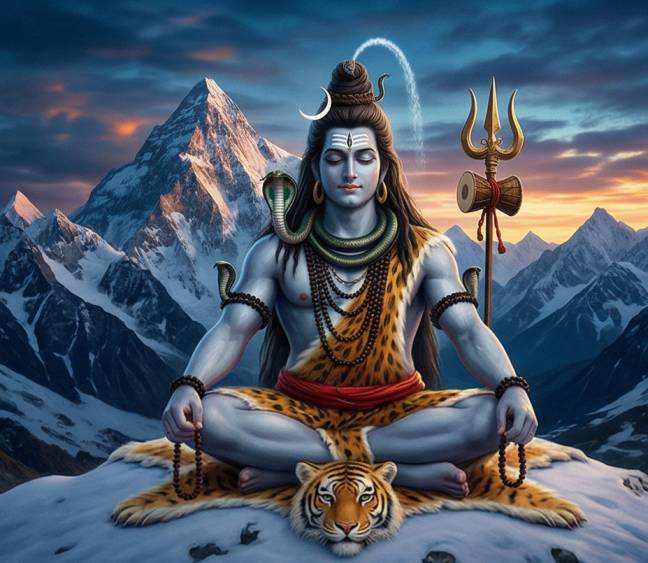
Perhaps the most iconic feature of Lord Shiva is his third eye, located on his forehead. This eye represents the eye of wisdom and spiritual insight. While our two physical eyes see the material world, the third eye sees the spiritual truth. When Shiva is provoked or when the world needs to be purged of evil, his third eye opens, emitting a fire that destroys everything in its path. It is a reminder that one must look beyond the physical world to see the ultimate truth.
The Serpent (Vasuki) and The Crescent Moon
Around his neck, Lord Shiva wears the serpent Vasuki. This symbolizes his control over the most dangerous forces of nature and his mastery over time and ego. The snake also represents the Kundalini energy, the dormant spiritual power within every human. On his matted hair rests a crescent moon, which represents the cyclical nature of time and his control over the mind and emotions. The moon’s phases symbolize the wax and wane of human experience, all of which Shiva transcends.
The Trishul (Trident) and Damru
The Trishul, or trident, is the primary weapon of Lord Shiva. Its three prongs represent the three Gunas (Sattva, Rajas, and Tamas) and his power to balance them. It also signifies his control over the past, present, and future. The Damru, a small hourglass-shaped drum, symbolizes the rhythm of the universe and the sound of creation (AUM). It is said that the entire Sanskrit language originated from the sounds of Shiva’s Damru.
Bhasma (Holy Ash) and Blue Throat (Neelkanth)
Shiva’s body is often covered in Bhasma, or holy ash, signifying the transient nature of life and the ultimate reality of death. It teaches us that the physical body is temporary and will eventually turn to ash. He is also called Neelkanth (the blue-throated one) because he consumed the Halahala poison that emerged during the churning of the cosmic ocean (Samudra Manthan) to save the universe. His blue throat is a testament to his compassion and his willingness to take on the world’s suffering.

3. The 12 Jyotirlingas of Lord Shiva: Sacred Abodes
The Jyotirlingas are the most sacred representations of Lord Shiva. A Jyotirlinga is a “column of light” that represents the infinite nature of Shiva. There are twelve such sites across India, and visiting them is considered a path to ultimate liberation.
- Somnath (Gujarat): Known as the “Eternal Shrine,” it is the first of the twelve Jyotirlingas.
- Mallikarjuna (Andhra Pradesh): Located on Srisailam mountain, it represents the union of Shiva and Shakti.
- Mahakaleshwar (Madhya Pradesh): Situated in Ujjain, this lingam is Dakshinamurti (south-facing), symbolizing the master of time and death.
- Omkareshwar (Madhya Pradesh): Located on an island in the Narmada river, the island itself is shaped like the symbol ‘OM’.
- Kedarnath (Uttarakhand): The highest of the Jyotirlingas, located in the Himalayas, it is accessible only for part of the year.
- Bhimashankar (Maharashtra): Associated with the legend of Shiva defeating the demon Tripurasura.
- Kashi Vishwanath (Uttar Pradesh): The most famous shrine in the holy city of Varanasi, the city of light.
- Trimbakeshwar (Maharashtra): Located near the source of the Godavari river, it features a unique lingam with three faces representing Brahma, Vishnu, and Shiva.
- Vaidyanath (Jharkhand): Known as the “Lord of Physicians,” it is where Shiva is worshipped as a healer.
- Nageshwar (Gujarat): Represents the lord of snakes and protection from poisons.
- Rameshwar (Tamil Nadu): Established by Lord Rama himself, it is a key site in the Ramayana.
- Grishneshwar (Maharashtra): The last of the Jyotirlingas, associated with the story of a devoted woman named Ghushma.
4. The Significance of the Shiva Lingam
The Shiva Lingam is the primary object of worship for Lord Shiva. It is a symbol that represents the formless, infinite, and eternal nature of the divine. The word “Linga” means “sign” or “symbol.” It is often placed on a circular base called the Yoni, which represents Goddess Shakti. Together, they symbolize the union of consciousness and energy, the fundamental duality of the universe.
Worshipping the Shiva Lingam with water, milk, and Bilva leaves is believed to purify the mind and soul. It is not an idol in the traditional sense but a focus for meditation on the absolute reality that has no beginning and no end.
5. Legends of Lord Shiva: Stories of Power and Grace
The mythology of Lord Shiva is filled with stories that illustrate his complex character—at once fierce and compassionate, solitary and family-oriented.
The Churning of the Ocean (Samudra Manthan)
One of the most significant stories is the churning of the cosmic ocean by the Devas (gods) and Asuras (demons) to obtain Amrit (the nectar of immortality). During the process, a deadly poison called Halahala emerged, threatening to destroy all creation. Lord Shiva, out of his infinite compassion, drank the poison. Goddess Parvati held his throat to prevent the poison from descending further, which turned his neck blue, earning him the name Neelkanth.
The Legend of Markandeya
Markandeya was a young devotee of Lord Shiva who was destined to die at the age of sixteen. When Yama, the god of death, came to take his soul, Markandeya clung to a Shiva Lingam and chanted the Mahamrityunjaya Mantra. Lord Shiva appeared from the lingam and drove Yama away, granting Markandeya eternal life. This story emphasizes that devotion to Shiva can transcend even death.
The Birth of Ganesha
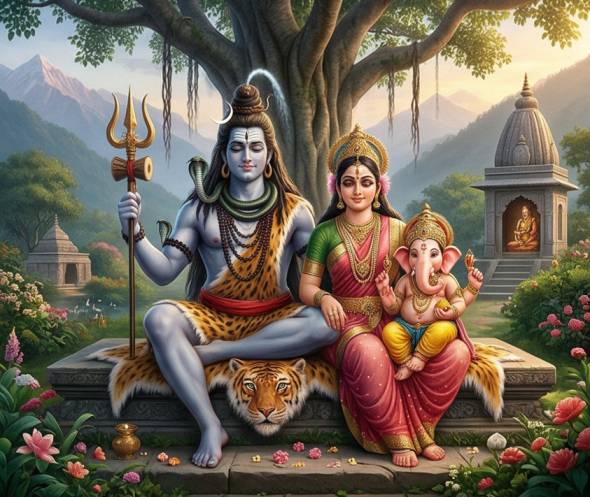
The story of Ganesha’s birth is a testament to the power of Lord Shiva and Parvati. Parvati created Ganesha from the sandalwood paste on her body to guard her while she bathed. When Shiva returned and was denied entry by Ganesha, a fierce battle ensued, and Shiva severed Ganesha’s head. Seeing Parvati’s grief, Shiva replaced the head with that of an elephant, breathing life back into him and making him the leader of his Ganas.

6. Lord Shiva’s Family: The Balance of Energy
While Lord Shiva is the ultimate ascetic, he is also the perfect householder. His family life represents the harmony required to sustain the universe.
The Union of Shiva and Parvati
The marriage of Lord Shiva and Goddess Parvati is a cosmic event. Parvati is the reincarnation of Sati, Shiva’s first wife. Her penance to win back Shiva’s love shows that spiritual effort is required to unite with the divine. Their relationship is one of mutual respect and equality, often depicted in the form of Ardhanarishvara—half man and half woman—signifying that the masculine and feminine are inseparable.
Ganesha and Kartikeya: Wisdom and Strength
Shiva’s sons embody the dual paths to the divine. Ganesha represents wisdom, intellect, and the removal of obstacles. Kartikeya represents strength, discipline, and the victory of good over evil. Together, they complete the divine family of Lord Shiva, teaching us that both inner wisdom and outward action are necessary for a balanced life.
7. Powerful Lord Shiva Mantras and Their Spiritual Benefits
Chanting mantras is a core practice for any devotee of Lord Shiva. These sacred sounds are believed to vibrate with the energy of the universe itself.
Om Namah Shivaya (The Panchakshara Mantra)
The most fundamental mantra is “Om Namah Shivaya.” Each syllable corresponds to one of the five elements:
- Na: Earth
- Mah: Water
- Shi: Fire
- Va: Air
- Ya: Space
By chanting this mantra, the devotee balances the elements within their own body and aligns themselves with the cosmic will of Lord Shiva.
Mahamrityunjaya Mantra: The Healing Prayer
This mantra is found in the Rig Veda and is dedicated to Tryambaka, the three-eyed Lord Shiva. It is a powerful tool for overcoming fear, especially the fear of death. It is often chanted for the health and well-being of loved ones.
The Mantra:
Om Tryambakam Yajamahe Sugandhim Pushti-Vardhanam
Urvarukamiva Bandhanan Mrityor Mukshiya Maamritat
Meaning: We worship the Three-eyed Lord, who is fragrant and who nourishes and nurtures all beings. As is the ripened cucumber freed from its bondage to the creeper, may He liberate us from death for the sake of immortality.
8. Major Festivals and Sacred Times
The worship of Lord Shiva reaches its peak during specific times of the year when the cosmic energies are said to be most aligned with his presence.
Maha Shivratri: The Great Night
Maha Shivratri is the most important festival for Shiva devotees. It is the night of the “Great Union” and the “Great Dance.” Devotees fast and stay awake all night, chanting “Om Namah Shivaya” and performing Abhishekam (ritual bathing) of the Shiva Lingam. It is believed that any spiritual practice performed on this night is a thousand times more effective.
Shravan Maas: The Holy Month
The Hindu month of Shravan is entirely dedicated to Lord Shiva. It is a time of rain and renewal. Devotees often carry water from sacred rivers to offer at Shiva temples (Kanwar Yatra). The Mondays of this month, known as Shravan Somvar, are particularly auspicious for fasting and prayer.
9. Lord Shiva and the Science of Rudraksha
Rudraksha beads are the seeds of the Elaeocarpus ganitrus tree and are considered the tears of Lord Shiva. Legend has it that after meditating for many years for the welfare of all beings, Shiva opened his eyes, and tears of compassion fell to the earth, becoming Rudraksha trees.
Wearing Rudraksha is believed to provide protection, reduce stress, and aid in meditation. Different “Mukhis” (faces) of Rudraksha are associated with different aspects of Lord Shiva and different planetary influences. The 5-mukhi Rudraksha is the most common and is said to bring peace and health.
10. Lord Shiva’s Connection to the River Ganges
One of the most beautiful symbols of Lord Shiva is the River Ganges flowing from his matted hair. When the river goddess Ganga was to descend to earth, her force was so great that it would have destroyed the world. To protect the earth, Shiva caught her in his hair, releasing her in gentle streams. This symbolizes Shiva’s role as the protector and the one who tames the wild forces of nature for the benefit of humanity.
11. Lord Shiva’s Teachings for the Modern Seeker
In today’s fast-paced world, the teachings of Lord Shiva are more relevant than ever.
- Detachment (Vairagya): Shiva’s life as a yogi teaches us that true happiness comes from within, not from material possessions.
- Fearlessness: As the conqueror of death, Shiva encourages us to face our fears with courage and faith.
- Equality: His form as Ardhanarishvara reminds us of the equal importance of all genders and the balance of energies.
- Transformation: Shiva’s role as the destroyer reminds us that change is inevitable and that we must destroy our limitations to grow.
12. Conclusion: Embracing the Grace of Mahadev
In conclusion, Lord Shiva is the eternal consciousness that pervades the entire universe. From the heights of Mount Kailash to the depths of the human heart, his presence is felt by those who seek him with devotion. Whether you are drawn to his fierce form as Rudra, his peaceful form as a meditator, or his compassionate form as Bholenath, the grace of Lord Shiva is available to all. By understanding his mythology, symbols, and mantras, you can embark on a transformative spiritual journey that leads to ultimate peace and liberation.
May the light of Lord Shiva illuminate your path. Om Namah Shivaya!
Read also Lord Hanuman, Lord Krishna