The Spiritual Call of Vaishno Devi
The Vaishno Devi yatra is not just a pilgrimage; it is a life-altering spiritual journey that draws millions of devotees from across the globe to the Trikuta Hills of Jammu and Kashmir. For a Hindu devotee, the “Bulaawa” (the call) from the Goddess is a moment of profound significance. Nestled at an altitude of 5,200 feet, the sacred cave of Mata Vaishno Devi is the abode of the Supreme Mother, who resides there in the form of three natural rock formations known as the Three Pindis.
As we look forward to Vaishno Devi yatra in 2026, it is essential for every pilgrim to be well-prepared. Whether it is your first visit or your tenth, the logistics of the trek, the registration process, and the timings for Aarti are crucial for a smooth and fulfilling experience. In this comprehensive guide, we will explore everything from the miraculous history of the shrine to the modern-day facilities like helicopter services and battery cars that make the 13 km trek accessible to everyone.
The Divine Origin and Legends of Vaishno Devi
The history of Vaishno Devi is steeped in ancient legends and Puranic texts. The most popular story dates back to the Treta Yuga, involving the divine birth of the Goddess from the combined energies of Maha Kali, Maha Lakshmi, and Maha Saraswati.
1. The Birth of Vaishnavi
The three Goddesses combined their spiritual strength to create a divine girl named Vaishnavi. She was born in the house of Ratnakar Sagar and was destined to lead a life of intense penance to merge with Lord Vishnu. Seeing her devotion, Lord Rama (an avatar of Vishnu) blessed her and told her that in the Kali Yuga, she would reside in the Trikuta mountains and fulfill the wishes of her devotees.
2. The Legend of Pandit Sridhar
The modern-day discovery of the sacred cave is attributed to a humble priest named Pandit Sridhar. He was a staunch devotee of the Goddess but was very poor. After a miraculous “Bhandara” (community feast) where the Goddess herself appeared as a young girl, she led him to the hidden cave in the mountains. Since then, the descendants of Pandit Sridhar have been the traditional priests of the shrine.
3. Bhairon Nath and the Significance of Forgiveness
Another vital part of the Vaishno Devi story is the chase by the tantric Bhairon Nath. After he pursued the Goddess for nine months (which she spent in the Ardh Kuwari cave), she finally took her divine form as Maha Kali and beheaded him. In his final moments, Bhairon Nath asked for forgiveness. The Goddess not only forgave him but granted him a boon: every devotee’s yatra would only be complete after visiting the Bhairon Mandir after the main darshan.
Vaishno Devi Yatra Registration 2026: Online and Offline
Registration is a mandatory step for every pilgrim. Without a Yatra Parchi (registration slip), you will not be allowed to proceed beyond the Banganga check post in Katra.
- Online Registration: This is the most recommended method. You can register on the official website of the Shri Mata Vaishno Devi Shrine Board (SMVDSB). Online booking for 2026 usually opens 60 days in advance.
- Offline Registration: If you haven’t booked online, you can get a physical registration slip at the Yatra Registration Counters (YRC) located near the Katra Railway Station and the main bus stand.
- RFID Cards: Recently, the Shrine Board has introduced RFID-based tracking cards. These are issued at the registration counters and must be worn at all times during the trek for safety and crowd management.
Best Time to Visit Vaishno Devi in 2026
While the shrine is open 365 days a year, the experience varies significantly with the seasons.
1. Spring and Summer (March to June)
This is the peak season. The weather is pleasant (15°C to 30°C), making the trek comfortable. However, expect huge crowds and long waiting times for darshan, sometimes extending to 15-20 hours.
2. Monsoon (July to September)
The hills are lush green and beautiful, but the path can be slippery. Landslides are a possibility, so check the weather forecast before starting your trek.
3. Autumn (October to November)
This is arguably the best time to visit Vaishno Devi. The air is crisp, the skies are clear, and the festival of Navratri brings a unique spiritual energy to the entire region. The “Sharad Navratri 2026” will be a grand affair with special decorations and Aarti.
4. Winter (December to February)
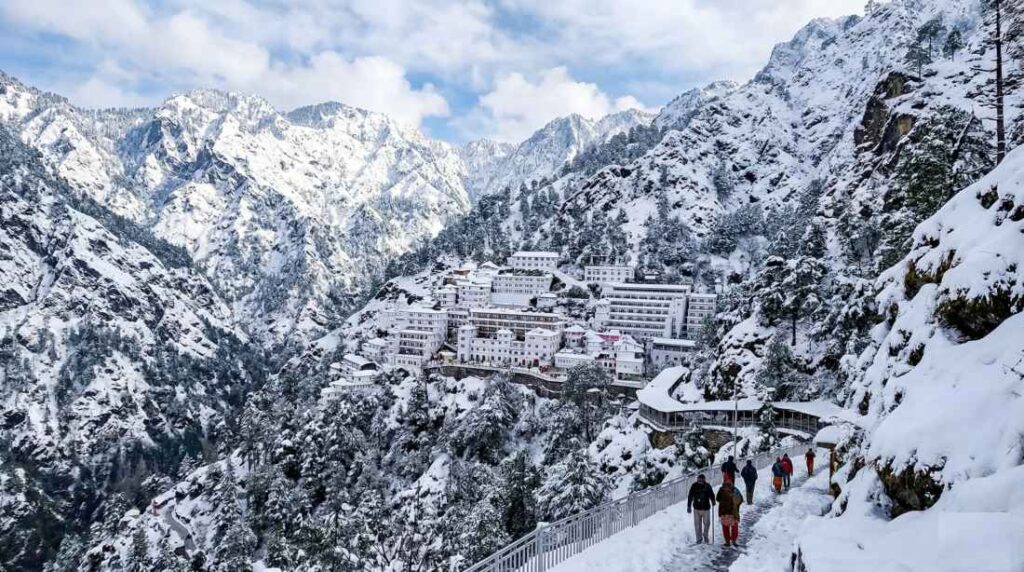
For those who love the snow, winter is magical. The Bhawan and the Bhairon Ghati often receive heavy snowfall. It is cold (-5°C to 10°C), so heavy woolens are mandatory. The crowd is much thinner during this time.
The Trekking Route: From Katra to Bhawan
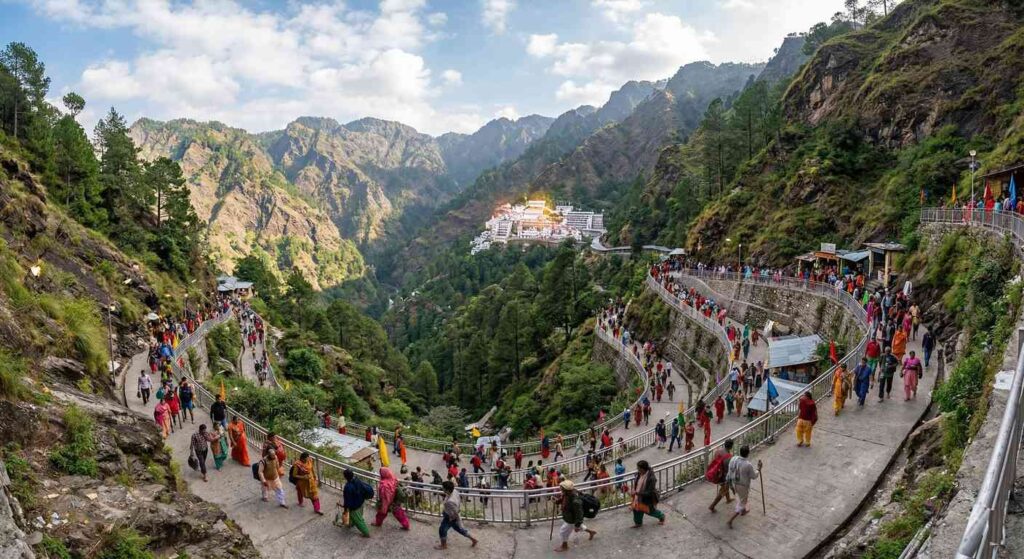
The journey begins at the base town of Katra. The total distance to the Bhawan is approximately 13 km.
1. Banganga (The Starting Point)
After passing the registration check, you reach Banganga. Legend says the Goddess shot an arrow into the ground to bring out a stream of water for her companion, the monkey. Many devotees take a holy dip here before starting the climb.
2. Charan Paduka
Located at 1.5 km, this is where the Goddess’s footprints are preserved on a rock. It is a tradition to bow here and seek strength for the rest of the journey.
3. Ardh Kuwari (The Midpoint)
At 6 km, you reach Ardh Kuwari. This is the site of the Garbhjun Cave, where the Goddess stayed for nine months. Passing through this narrow cave is believed to cleanse the devotee of past sins. The waiting list for Garbhjun can be very long (sometimes 24-48 hours), so plan accordingly.
4. Sanjichhat
This is the highest point of the trek (around 9 km from Katra). It offers a panoramic view of the valley and is the location of the helipad. From here, the path is mostly flat or downhill towards the Bhawan.
5. The Main Bhawan
Finally, you reach the Bhawan. After depositing your belongings in the free lockers, you join the queue for darshan. Inside the cave, you will see the Three Pindis:
- Maha Kali: Representing the power of time and destruction of ego.
- Maha Lakshmi: Representing wealth, prosperity, and maintenance.
- Maha Saraswati: Representing wisdom, arts, and knowledge.
Facilities and Transport Options for 2026
The Shrine Board has made incredible efforts to make the Vaishno Devi yatra accessible to the elderly and the physically challenged.
- Helicopter Services: Operates between Katra and Sanjichhat. It takes only 8 minutes and costs around ₹2,100 per person (one way). Booking must be done well in advance on the official website.
- Battery Cars: Available on the Tarakote Marg (the new alternative route) for senior citizens and differently-abled persons.
- Palkis and Ponies: Traditional modes of transport available throughout the route. Rates are fixed by the government and are usually displayed at the starting points.
- Pithoos: Porters who carry luggage or even children in baskets on their backs.
Accommodation: Where to Stay in Katra and Bhawan
Finding the right place to stay is key to a restful yatra.
1. Staying in Katra
Katra has hundreds of hotels ranging from budget guest houses to 5-star resorts. It is best to stay near the Railway Station or the Bus Stand for easy access to the registration counters.
2. Staying at the Bhawan/Sanjichhat
The Shrine Board provides dormitory-style accommodation and private rooms at the Bhawan, Sanjichhat, and Ardh Kuwari. These must be booked online via the official website. Staying at the Bhawan allows you to participate in the early morning or late night Atka Aarti.
Navratri 2026 at Vaishno Devi: A Spiritual Extravaganza
Navratri is the most important festival at the shrine. During these nine days, the Bhawan is decorated with tons of exotic flowers from across the world. Special “Shat Chandi Mahayagya” is performed for the peace and prosperity of the world. If you plan to visit during Navratri 2026, be prepared for massive crowds but an unparalleled spiritual atmosphere.

Important Tips for a Successful Vaishno Devi Yatra
To ensure your journey is safe and comfortable, keep these tips in mind:
- Light Packing: Carry only essentials. Heavy luggage can be deposited in Katra at the cloakrooms.
- Comfortable Footwear: Wear sturdy walking shoes or sneakers. Avoid new shoes as they can cause blisters.
- Stay Hydrated: Drink plenty of water and carry some energy bars or dry fruits.
- Avoid Plastics: The entire Trikuta region is a plastic-free zone. Please do not litter.
- Health Check: If you have heart or respiratory issues, consult a doctor before attempting the trek.
- Follow the Rules: Photography and videography are strictly prohibited inside the cave and at certain points of the Bhawan.
How to Reach Katra: Connectivity in 2026
Katra is well-connected to the rest of India.
- By Train: The Shri Mata Vaishno Devi Katra (SVDK) railway station is modern and well-served by trains like the Vande Bharat Express and the Him-Sagar Express.
- By Air: The nearest airport is in Jammu (IXJ), which is about 50 km from Katra. You can take a taxi or a bus from the airport to Katra.
- By Road: Regular bus services are available from major cities like Delhi, Amritsar, and Chandigarh.
Nearby Attractions Around Katra: Extending Your Spiritual Journey
If you have an extra day or two after your Vaishno Devi yatra, there are several beautiful places near Katra that are worth visiting:
- Shiv Khori: Located about 70 km from Katra, this is a naturally formed cave dedicated to Lord Shiva. The cave is famous for its natural stalagmite lingam.
- Patnitop: A beautiful hill station about 85 km from Katra, perfect for families who want to enjoy some mountain scenery and adventure activities like paragliding.
- Nau Devi Temple: Situated just 10 km from Katra, this temple is located inside a small cave and is dedicated to nine forms of Goddess Durga.
- Jhajjar Kotli: A scenic picnic spot with a small stream, ideal for relaxing after the tiring 13 km trek.
Essential Items to Carry for the Vaishno Devi Trek
To make your trek more comfortable, ensure you have these items in your backpack:
- A Small Torch: Useful if you are trekking at night.
- Light Woolens: Even in summer, the temperature at the Bhawan can drop significantly at night.
- Raincoat/Umbrella: Sudden rain showers are common in the Trikuta mountains.
- First-Aid Kit: Carry basic medicines for headaches, muscle pain, and band-aids for blisters.
- Energy Food: Keep some glucose, energy bars, and nuts handy for an instant boost.
Conclusion: The Eternal Grace of Mata Vaishno Devi
The Vaishno Devi yatra is more than just a physical climb; it is a test of your faith and endurance. As you shout “Jai Mata Di” along with thousands of other pilgrims, you feel a sense of unity and strength that is hard to find anywhere else. The Goddess is known as “Moohn Maangi Muradein Poori Karne Wali Mata” (The Mother who fulfills all wishes), and no one returns from her door empty-handed.
As you plan your visit in 2026, let the spirit of devotion guide you. Whether you trek on foot or take a helicopter, the ultimate goal is to connect with the divine motherly energy that has blessed this land for eons. For more spiritual insights and guides on Hindu pilgrimages, explore our articles on Lord Vishnu and Lord Rama.
Jai Mata Di! May your yatra be blessed!