Introduction to the Supreme Personality: Lord Krishna
In the vast and colorful tapestry of Hindu spirituality, Lord Krishna stands as the most vibrant and multifaceted figure. Worshipped as the eighth avatar of Lord Vishnu, Krishna is the personification of love, wisdom, and divine protection. His life, often referred to as “Krishna Leela,” is not merely a collection of ancient myths but a profound source of inspiration for billions of people worldwide. From the playful child of Vrindavan to the master strategist of the Mahabharata, Krishna represents the ideal blend of the human and the divine.
As we navigate the complexities of the 21st century, the teachings of Lord Krishna remain more relevant than ever. His message of “Karma Yoga” (selfless action) provides a powerful antidote to modern-day stress and anxiety. In this comprehensive 2026 guide, we will explore the depths of his miraculous birth, his enchanting childhood, his reign as the King of Dwarka, and the eternal wisdom he bestowed upon humanity through the Bhagavad Gita. We will also look at the historical and archaeological evidence that bridges the gap between faith and fact.

The Miraculous Birth and Divine Protection
The arrival of Lord Krishna on Earth was marked by celestial signs and a battle against tyranny. He was born in the dark, damp prison cells of Mathura to Devaki and Vasudeva. At that time, Mathura was ruled by the cruel King Kamsa, Devaki’s brother. Kamsa had been warned by a divine voice that the eighth child of Devaki would be the cause of his death. Driven by fear and ego, Kamsa imprisoned his own sister and killed her first six children.
The seventh child, Balarama, was miraculously transferred to the womb of Rohini to save him. When the eighth child, Krishna, was born at midnight on the auspicious day of Janmashtami, the universe celebrated. The prison guards fell into a supernatural slumber, and the heavy iron gates swung open. Vasudeva, guided by a divine voice, carried the infant Krishna in a basket across the turbulent Yamuna River. To protect the Lord from the pouring rain, the five-headed serpent Sheshanaga appeared and served as an umbrella. Krishna was safely exchanged with the daughter of Yashoda and Nanda in the village of Gokul, where he would be raised far from Kamsa’s reach.
The Enchanting Childhood of Vrindavan
The childhood of Lord Krishna in Gokul and later in Vrindavan is a period of pure joy and divine miracles. Known as Bal Krishna, he was the darling of the entire community. These stories, while seemingly simple, carry deep spiritual metaphors about the relationship between the individual soul and the Supreme Divine.
The Butter Thief and the Soul’s Longing
Krishna was famously called Makhan Chor (the butter thief). He and his friends would often raid the houses of the gopis (milkmaids) to steal freshly churned butter. Spiritually, this symbolizes the Lord “stealing” the hearts of his devotees. The white butter represents the pure, churned devotion of the heart, which the Lord finds irresistible.
Miracles and Protection
Even as a child, Krishna faced numerous assassins sent by Kamsa, including the demoness Putana and the whirlwind demon Trinavarta. Each time, Krishna effortlessly defeated them, proving his divine nature. One of his most iconic feats was taming the serpent Kaliya, who had poisoned the Yamuna River. By dancing on Kaliya’s hoods, Krishna didn’t just defeat the snake but purified the environment, teaching us the importance of overcoming internal and external negativity.
Lifting Mount Govardhan
To humble Lord Indra, the King of Heaven, who had sent torrential rains to punish the villagers, a young Krishna lifted the massive Govardhan Hill on his little finger. For seven days and nights, he provided shelter to all the people and animals of Vrindavan. This act established Krishna as the ultimate protector and shifted the focus of worship from external rituals to a direct, loving relationship with the divine.

Radha and Krishna: The Mystery of Divine Love
No discussion of Lord Krishna is complete without mentioning Radha. While Radha is not explicitly mentioned in the earliest scriptures like the Mahabharata, she is the central figure in the Bhakti traditions of the medieval era. The love between Radha and Krishna, known as Radha-Krishna, is considered the highest form of spiritual devotion.
The Rasa-lila
The Rasa-lila is the divine dance of love that took place in the forests of Vrindavan. On full moon nights, Krishna would play his flute, and the gopis would leave everything to join him. Through his divine power, Krishna would multiply himself so that each gopi felt she was dancing with him alone. This dance is a metaphor for the Jivatma (individual soul) merging with the Paramatma (Supreme Soul).
Radha as the Embodiment of Devotion
Radha represents the peak of devotion. She is often seen as the “Hladini Shakti” or the internal pleasure potency of Krishna. Their relationship teaches that God is not a distant judge but a beloved friend and lover who can be reached through pure, unalloyed love. In many temples, Krishna is never worshipped alone but always alongside Radha, signifying that the Lord and his Devotion are inseparable.
Krishna as the King of Dwarka
After fulfilling his mission in Mathura by killing Kamsa, Lord Krishna did not stay to rule. Instead, he led the Yadava clan to the western coast of India to establish a new kingdom: Dwarka. This transition marks Krishna’s evolution from a playful cowherd to a powerful and wise monarch.
The Construction of the Golden City
Legend has it that Krishna requested Lord Vishwakarma, the celestial architect, to build a city that was unparalleled in its beauty and security. Dwarka was built on land reclaimed from the sea and was known as “Suvarna Dwarka” (Golden Dwarka) because its palaces were adorned with gold and precious gems. As the King of Dwarka, Krishna managed the complex affairs of his large family and the Yadava administration with perfect detachment.
Family and Lineage
In Dwarka, Krishna married eight principal queens, including Rukmini (the incarnation of Goddess Lakshmi) and Satyabhama. He had many children, the most prominent being Pradyumna. Despite being a king and a householder, Krishna remained a “Yogeshwara,” a master of all yoga, showing that one can be in the world but not of the world.
The Role of Krishna in the Mahabharata
Lord Krishna is the central figure of the great epic, the Mahabharata. His role as a diplomat, strategist, and spiritual guide was crucial in the victory of the Pandavas over the Kauravas.
The Peace Mission
Before the war of Kurukshetra began, Krishna went to the court of Hastinapur as a messenger of peace. He tried his best to prevent the bloodshed, even asking for just five villages for the Pandavas. When the arrogant Duryodhana refused and even tried to imprison Krishna, the Lord revealed his Vishwaroop (universal form), showing that he was the master of the entire creation.
Protection of Draupadi
One of the most moving stories is Krishna’s protection of Draupadi during the infamous dice game. When she was being humiliated in the royal court and no one came to her aid, she surrendered completely to Krishna. He miraculously provided her with an endless supply of clothing, saving her dignity and teaching the world that the Lord always protects those who surrender to him.
The Charioteer of Arjuna
During the war, Krishna chose not to fight with weapons. Instead, he became the charioteer for his dear friend Arjuna. This role, known as Parthasarathi, is deeply symbolic. The chariot represents the human body, the horses represent the senses, and Krishna as the driver represents the divine intellect that should guide our lives.
The Bhagavad Gita: The Song of God
The most significant legacy of Lord Krishna is the Bhagavad Gita. Spoken in the middle of the battlefield, it is a 700-verse manual for life that has been studied by philosophers, scientists, and spiritual seekers for thousands of years.
The Three Paths to Liberation
In the Gita, Krishna outlines three primary paths for human evolution:
- Karma Yoga: The path of selfless action. Krishna teaches that we should do our duty without being attached to the results. “You have a right to perform your prescribed duties, but you are not entitled to the fruits of your actions.”
- Bhakti Yoga: The path of devotion. Krishna emphasizes that a heart filled with love for the divine is the fastest way to reach him.
- Jnana Yoga: The path of knowledge. Krishna explains the nature of the soul, the body, and the supreme reality, helping Arjuna overcome his delusion.
The Concept of Dharma
The entire Gita is a discourse on Dharma (righteousness). Krishna explains that sometimes, to protect the higher Dharma, one must perform difficult duties. He encourages Arjuna to fight not out of anger or greed, but as a sacred duty to restore balance to the world.
Historical and Archaeological Perspectives
For many years, the life of Lord Krishna was considered purely mythological by Western historians. However, recent scientific and archaeological findings have provided strong evidence for his historical existence.
The Submerged City of Dwarka
In the 1980s, marine archaeologists led by Dr. S.R. Rao discovered a submerged city off the coast of modern-day Dwarka in Gujarat. The findings included massive stone walls, citadels, and stone anchors that match the descriptions found in the Mahabharata. These ruins are estimated to be over 5,000 years old, aligning with the traditional timeline of Krishna’s life.
Astronomical Dating
Using advanced planetarium software, researchers have analyzed the celestial descriptions in the Mahabharata. The positions of the planets and the timing of eclipses mentioned in the text point to a historical date around 3102 BCE for the beginning of the Kali Yuga, which traditionally marks the departure of Krishna from the Earth.
Iconography and Symbolism of the Divine Form
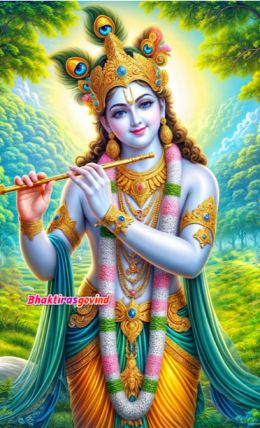
The image of Lord Krishna is rich with symbolism. Every element of his appearance carries a spiritual lesson.
- The Blue Skin: Like the vast sky and the deep ocean, the blue color represents the infinite, all-pervading nature of the Lord.
- The Peacock Feather: Symbolizes the beauty and diversity of the creation. It also represents the hundreds of “eyes” that the Lord uses to watch over his devotees.
- The Flute: Represents the human heart. When we empty our hearts of ego and selfishness, the Lord can play his divine music through us.
- The Yellow Silk (Pitambara): Represents the fire of knowledge and the purity of the soul.
- The Cow: Symbolizes the Earth and the principle of non-violence. Krishna as “Gopala” is the protector of all living beings.
Modern Influence: The Global Spread of Krishna Consciousness
Today, the influence of Lord Krishna has transcended the borders of India. Through the work of the International Society for Krishna Consciousness (ISKCON), founded by A.C. Bhaktivedanta Swami Prabhupada, millions of people in the West have embraced the path of Bhakti. The chanting of the “Hare Krishna” mantra can now be heard in almost every major city in the world, from London to New York to Tokyo.
Krishna’s teachings on meditation, vegetarianism, and spiritual living have found a home in the modern wellness movement. His life continues to be a subject of study in universities and a source of inspiration for artists, musicians, and filmmakers.

How to Worship Lord Krishna in 2026
Worshipping Lord Krishna is about cultivating a personal relationship with the divine. Here are some ways to bring his energy into your life:
1. Chanting and Meditation
The Maha Mantra is the most recommended practice for the current age:
“Hare Krishna, Hare Krishna, Krishna Krishna, Hare Hare / Hare Rama, Hare Rama, Rama Rama, Hare Hare”
Regular chanting is said to bring inner peace and spiritual clarity.
2. Reading the Scriptures
Make it a habit to read at least one verse of the Bhagavad Gita or the Shrimad Bhagavatam every day. Contemplating the Lord’s words and his “Leelas” helps in aligning our lives with Dharma.
3. Offering Food (Prasadam)
Krishna says in the Gita, “If one offers Me with love and devotion a leaf, a flower, a fruit or water, I will accept it.” Preparing simple, vegetarian food and offering it to the Lord before eating is a beautiful way to practice mindfulness and gratitude.
4. Celebrating Festivals
Participate in festivals like Janmashtami (his birth), Holi (the festival of colors), and Govardhan Puja. These celebrations are opportunities to connect with the community and recharge your spiritual energy.
Conclusion: The Eternal Presence of the Flute Player
Lord Krishna is not a figure of the past; he is an eternal reality. Whether he is the naughty child stealing butter, the divine lover playing the flute, or the supreme teacher on the battlefield, he remains the “Jagadguru”—the teacher of the world. By opening our hearts to his message, we can transform our lives from a struggle for survival into a celebration of the divine.
As we move forward into 2026 and beyond, let the wisdom of Lord Krishna be our guiding light. Let his love be our strength, and let his divine flute music remind us of the eternal peace that lies within.
Jai Shri Krishna! Radhe Radhe!
Read also Lord Hanuman